
Decoding Taste

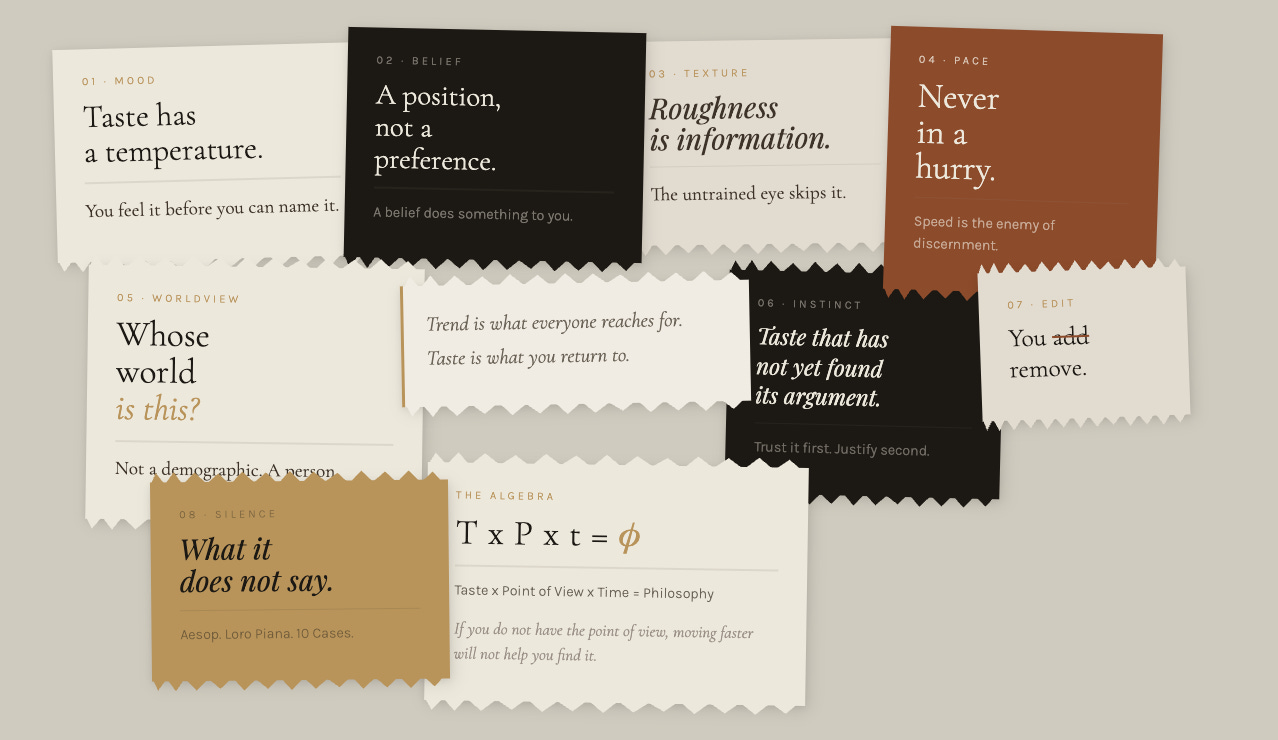
The taste-as-moat claim has become consensus in 2026.
CMOs, creative directors, founders with vibe coded products - all circling the same argument: AI cannot replicate taste, and if you have it, you win.
Maybe it is comforting. It is also strategically dishonest.
What is taste, actually?
How does it form?
And does it differentiate enough, in a world where anyone can generate aesthetically sophisticated output in seconds, to defend anything at all?
Taste - the word - is doing a lot of work right now - like saying storytelling is a moat in 2025. Unlike storytelling, taste needs to be decoded to really understand how to apply it - if you even have the patience and bravery to do so.
---
Before we called it taste
The ancient Greeks did not use the word taste to describe aesthetic judgment. They had kairos: the capacity to perceive the right moment. It was not about beauty in the abstract. It was about resonance. The rhetorician who knew which argument would land in this room, with these people, at this moment, was exercising the same faculty we now call taste.
The Romans had decorum. Not beauty as a fixed quality but appropriateness. The judgment of what fit. Cicero wrote about it in the context of oratory but also dress, behaviour, architecture. The ability to read a situation and respond at the right register was considered a mark of the educated person.
Renaissance Italy gave us disegno. A word meaning both drawing and design, but carrying something deeper: the ability to hold an idea of the whole in the mind and judge how well the parts were realising it. Vasari described it as a divine gift mediated by training and exposure. His Lives of the Artists was partly a taxonomy of who had it and who did not. His judgments shaped what the next generation of painters and patrons believed was worth making and worth owning.
By the 17th century, the philosopher Jonathan Richardson had formalised what had been an informal practice of connoisseurship into something approaching a discipline. He argued aesthetic judgment could be trained. Not purely innate, but a product of exposure, comparison, and accumulated looking. He even devised an eighteen-point scale for evaluating paintings, trying to make taste legible and shareable. He was, in his way, trying to decode it.
By the 18th century the word itself had arrived. Hume argued it was a sentiment, not something provably right or wrong, but a judgment formed by exposure and refined by practice. The true judge had seen enough, felt enough, compared enough to know the difference between the merely agreeable and the genuinely excellent. Kant went further: when we call something beautiful, we implicitly claim that others should agree. Taste, for Kant, is not purely personal. It aspires to something universal even when it cannot prove it.
What this history tells us is that the thing people are now calling taste has been one of the central preoccupations of human culture for over two thousand years. The word changed. The need to name and exercise this capacity did not. Every generation has reinvented the concept because every generation has needed to answer the same question: in a world full of things, how do you know which ones are great? It is not always objective. But it is not purely personal either. It is a byproduct of subconscious training, and that distinction matters more now than it ever has.
Brand science has tried to codify taste. Luxury has codified taste. Graphic design has codified taste. Why is it still so intangible?
---
How taste actually impacts people…
If taste is a moat it must do something. It must act on people before they can sense it.
I have been looking at how people describe their encounters with brands that resonate - that communicate in alignment with something they have internalised about what belongs in their world. Not the brand strategy narrative. The unfiltered conversations on forums, in reviews, in interviews with people who love things and are trying to explain why.
A writer describing Aesop: "Even though you can't quite name the vibe, you feel it. You don't just buy Aesop."
A menswear commentator on Loro Piana, after 25 years of buying sporadically: "I bought a navy mock-neck which had a fashioning structure I'd never seen anywhere, and was just beautiful. I have yet to see anything like it anywhere else."
The costume designer on Succession, describing how she researched how the ultra-wealthy dressed: "We would literally mimic what they were touching, feeling. The appeal of clothing to this kind of person is just in the fabrication of the garment."
None of these people are using the word taste. All of them are describing what taste does to them: a recognition event, a quality of stillness, a feeling of encountering something that exists entirely on its own terms and is entirely sure of itself.
You do not evaluate it. You either recognise it or you don't.
Pierre Bourdieu spent his career trying to explain why recognition is not random. His argument in Distinction was that taste is not personal - it is absorbed.
The preferences we develop for music, food, design, and language are shaped by the class we were born into, the institutions we moved through, the cultural capital accumulated through exposure over time. "Taste classifies," he wrote, "and it classifies the classifier."
When someone encounters a brand whose taste map matches their own internalised sense of what belongs, the recognition is immediate - not because the thing is beautiful in the abstract, but because it aligns with something built through years of exposure that the person could not fully articulate if asked.
This has a precise commercial implication. What we call brand loyalty is often, at its core, this alignment event repeating. The customer keeps returning not because they have consciously evaluated the brand's attributes but because every encounter confirms an internalised sense of who they are and what belongs in their world. Remove the brand and see what remains. If the customer feels genuinely disconnected, that is taste working as a moat. If they simply switch, it wasn't. A great example of this on a personal level is my grocery preferences. I only buy brands that have an artisan aesthetic - even if it is a gimmick. Growing up, my father used to bring home packaged goods from Europe - manly Italy. We never had Kraft or American CPG products in our kitchen. In my subconscious - packaging should resemble that feeling.
Byron Sharp's work on how brands grow demonstrates that brand choice happens primarily before conscious deliberation begins. Mental availability, the probability that a brand comes to mind in a buying situation, is built through the accumulation of consistent signals in memory over time. Colour, sound, shape, name phonology: these are not decorative choices. They are coded into memory before the rational mind arrives.
What taste does, at the brand level, is determine the quality and coherence of those signals. A brand with taste deposits memories that are distinctive and emotionally resonant. A brand without it deposits noise. The memory structure that forms is different in kind, not just in degree.
One line from a recent piece on what winning brands do differently captures this better than most strategy documents I have read: "Taste, rather than frequency, compounds into authority."
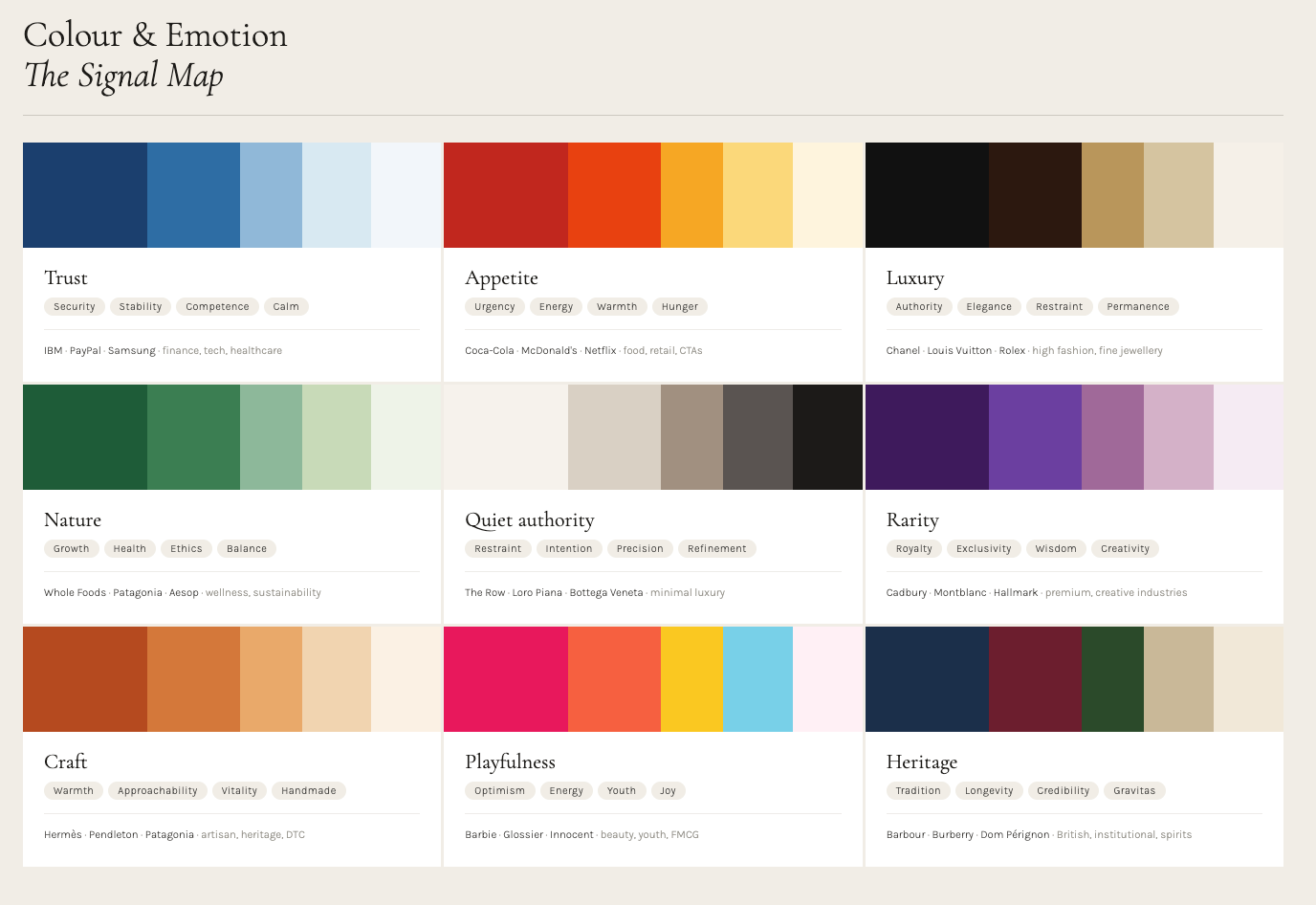
We take small things for granted - the colour signal map below is a great example. Our mind interprets the meaning of colour before we even form a conscious decision about it’s meaning. A combination of colours tells a story.
---
So is this taste conversation even useful?
Three things are being mixed up that need to be separated.
The first is taste and aesthetic preference. They are not the same. Aesthetic preference is having strong opinions. Taste is knowing what something is trying to be, and judging how well it is succeeding on its own terms - not your terms, not market convention, its own terms. A brand can have entirely consistent aesthetic preferences and no taste whatsoever, because none of it coheres around a point of view. The aesthetic is present. The intention it is in service of is absent. This is why so much AI-assisted brand work looks coherent and feels hollow.
The second conflation is taste and brand. A brand is a memory structure built in the minds of the market through repeated exposure to consistent signals over time. Taste is an input into that structure - not the structure itself. You can have extraordinary taste and a weak brand because you have never been consistent or present enough for memory structures to form. You can have ordinary taste and a strong brand because you have been relentlessly consistent about something for long enough.
The third is the founder's taste and the organisation's taste. When people say taste is the moat, they usually mean the taste of a specific person. That is real. But it is fragile - it does not transfer unless someone has done the hard, largely invisible work of translating personal judgment into institutional principles: the constraints, the rejection criteria, the hiring decisions, the things you say no to when the data says yes. Most founders never do this translation. What looks like a brand built on taste is often a brand built on one person's taste or values.
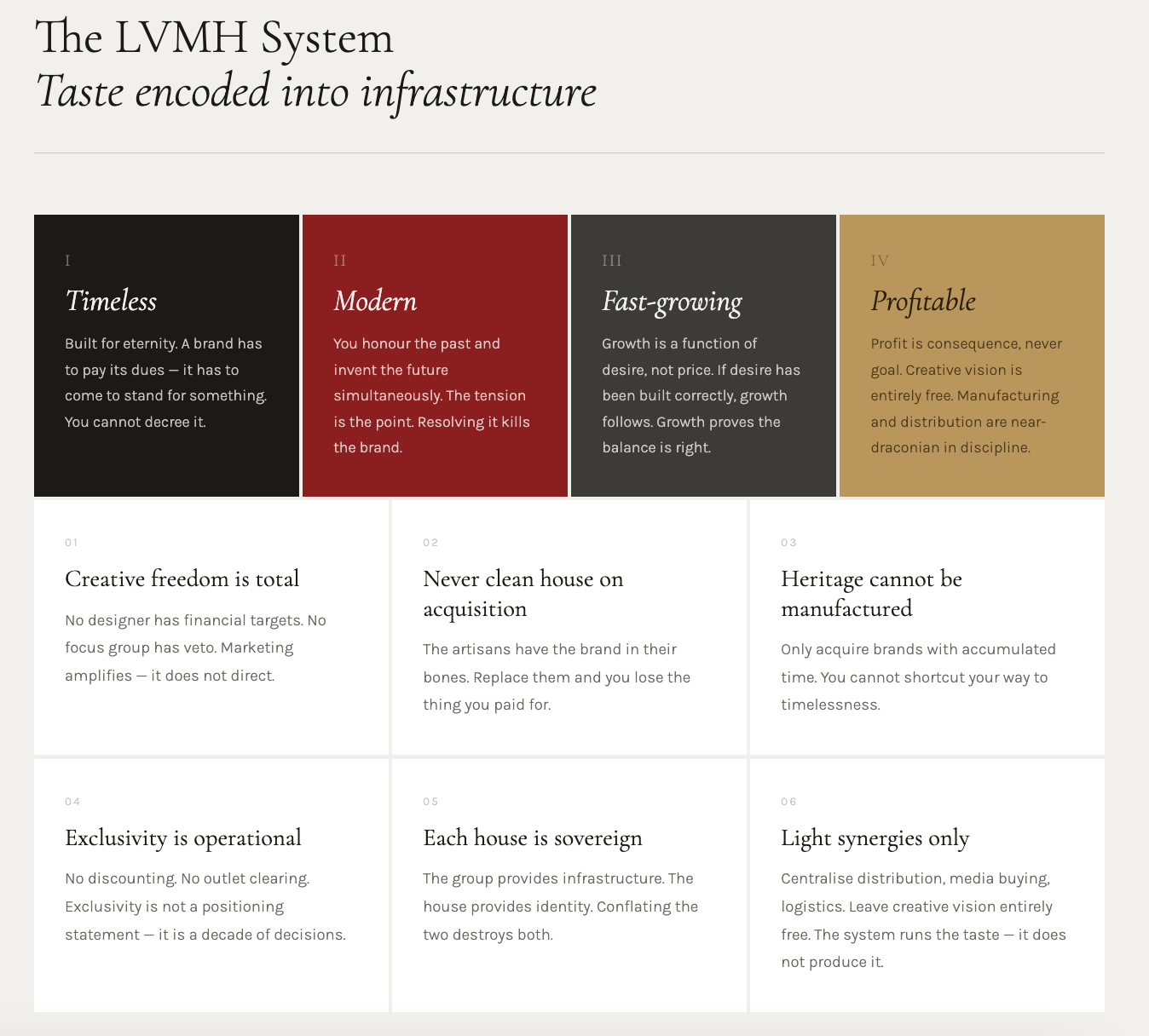
This is what Bernard Arnault understood before most. What he built at LVMH was not a collection of taste. It was a machine for encoding taste into systems - creative autonomy for each house's designers, rigorous operational control across the portfolio, and a rule Arnault was explicit about: never clean house on acquisition. The artisans had "the brand in their bones," he said. Remove them and you remove the institutional memory you paid for. The creative directors at Dior and Louis Vuitton have taste. The moat is the infrastructure underneath their taste - the heritage, the discipline, the refusal to chase what converts today at the cost of what compounds over a decade. When you pick up a garment in a Loro Piana store, the former CEO said, the customer wants to feel "part of a club of connoisseurs." That feeling was built over a century of consistent decisions, most of which nobody individually noticed.
When I look at the LVMH system and reflect on how the technology industry works - so many of the rules required to cultivate a taste driven business are absent in technology - so it is curious to me that the technorati suddenly think that taste is going to become a core part of their strategy when operationally the formation of it goes against the way tech operates. Intangibles rarely have a seat at the table.
---
Can AI have taste? How does it support the development of taste?
AI is a mimic, not an approximator. Mimicry reproduces the surface pattern without the underlying philosophical structure. It can produce a convincing single encounter. It cannot compound. What taste builds at the brand level is a compounding memory structure - thousands of coherent decisions over time that the market eventually internalises without consciously processing.
Assisted AI is a different thing entirely: a person with a coherent point of view using AI as a faster path to expression. The outputs can be extraordinary. But the point of view is prior. The tool did not generate it, and the tool cannot substitute for it.
What AI is exposing right now is the difference between brands that had a coherent point of view expressed through consistent decisions, and brands that had good execution covering for the absence of one. The second group can now produce beautiful, fast, technically impressive content at scale. It is aesthetically sophisticated and strategically incoherent. Every piece is good enough. Nothing compounds into something the market can recognise and return to. This is why I remain unconvinced that agentic AI can be an autonomous creative engine - I see posts celebrating an agentic Tiktok agent or another one that makes Instagram slop. Standing for something takes time and reflection - that tactic knowledge and philosophy can’t be programmed into AI.
---
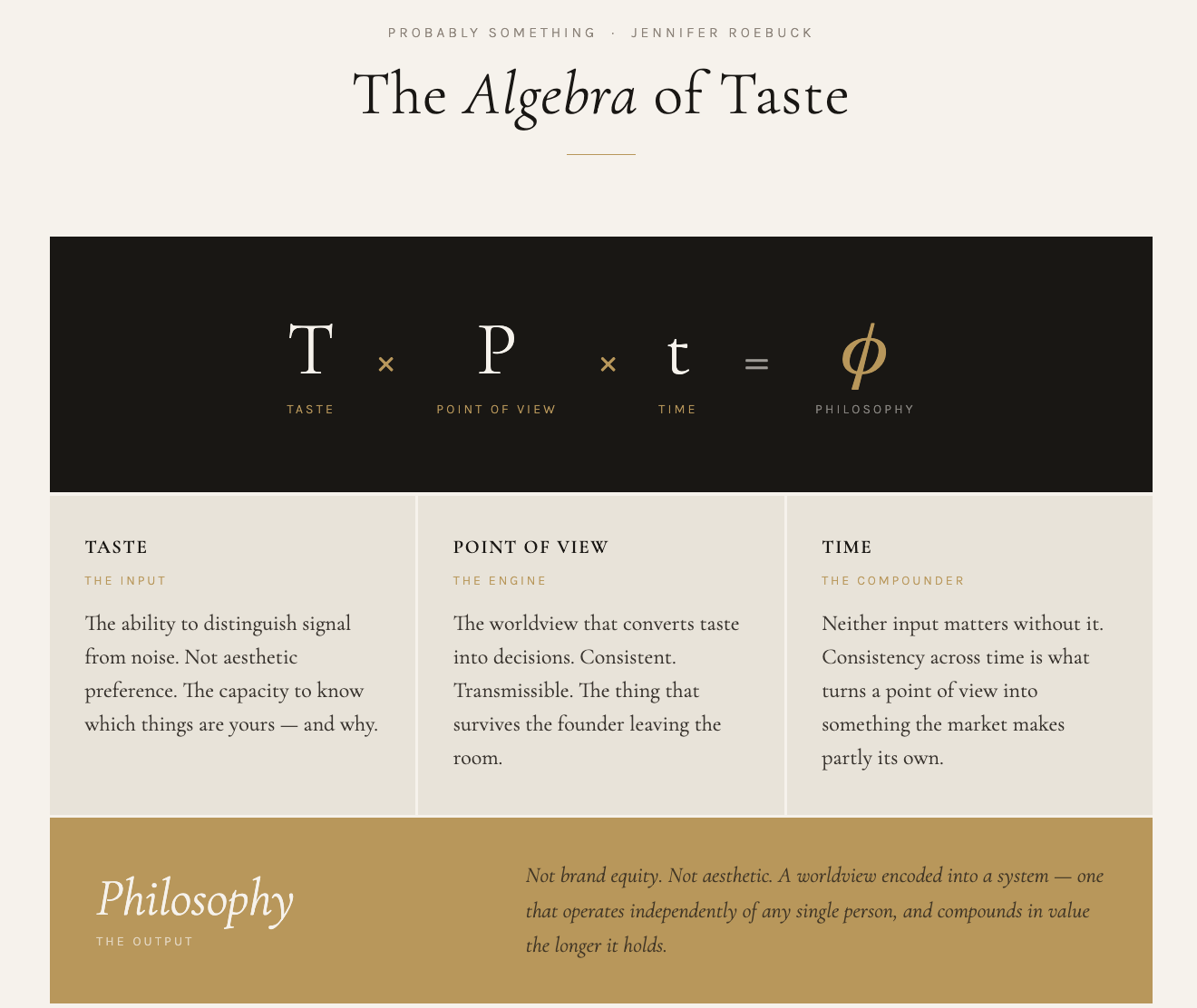
The algebra of taste - if that is what we want to call it -
The moat is not taste. The moat is what taste produces when it is exercised consistently enough, through a system robust enough, over time long enough, that the market builds something in memory that takes real effort to displace.
Brand building is the closest thing to this - and in design is can be a philosophy.
.
Taste is the input. Point of view is the engine. Time is the compounder. And what accumulates, when all three work together and someone had the discipline to encode it into the system rather than keep it in their head, is not brand equity. It is philosophy. A position about what the world should look and feel like that the market has, over time, made partly its own.
That is what Patagonia is. That is what Loro Piana is. That is what Dior is. Not brands with taste. Worldviews that enough people have internalised that displacing them would require dismantling something inside the people who hold them.
If you do not already have the point of view, using AI faster will not help you find it. It will just make the absence more visible, at greater speed.
Hey Jennifer! I always feel the same way but I just wasn't able to put it in words with such clarity. I am gonna come back to this article every time I do a branding/strategy project. Thanks a lot for writing this.
This is a very underrated article.